AI Coding Factories
Over the past year, the reliability of AI in coding has surged dramatically, and this upward trend shows no signs of slowing down. By this time next year, industry benchmarks and vendor roadmaps suggest that AI agents will be adept at handling the majority of routine bug fixes and boilerplate code with production-grade accuracy. This frees human developers to focus on higher-level design, innovative problem-solving, and strategic product thinking.
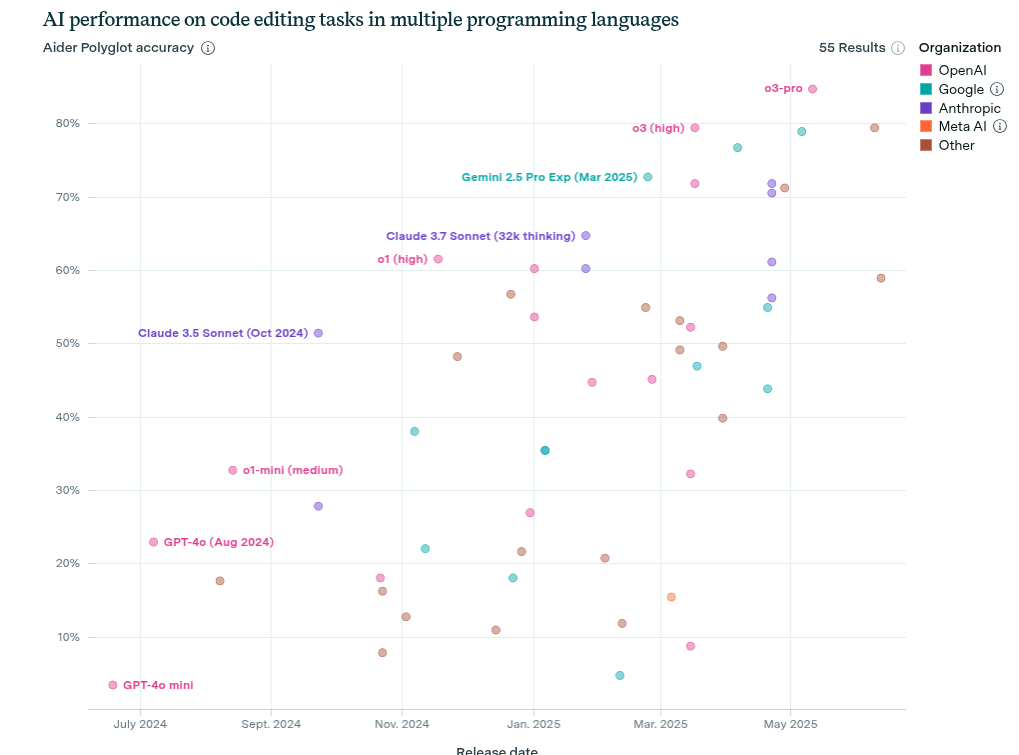
We’ve moved through several distinct phases of AI assistance, each building on the last:
- autocompletion of a few lines of code
- single-file generation & editing
- multi-file context & refactoring
- autonomous iterative loops that can run tests and access the CLI
The logical culmination of this evolution is the AI coding factory: a powerful new paradigm where hundreds of autonomous agents work in parallel under human supervision to deliver features at an unprecedented scale.
How the AI Coding Factory Works
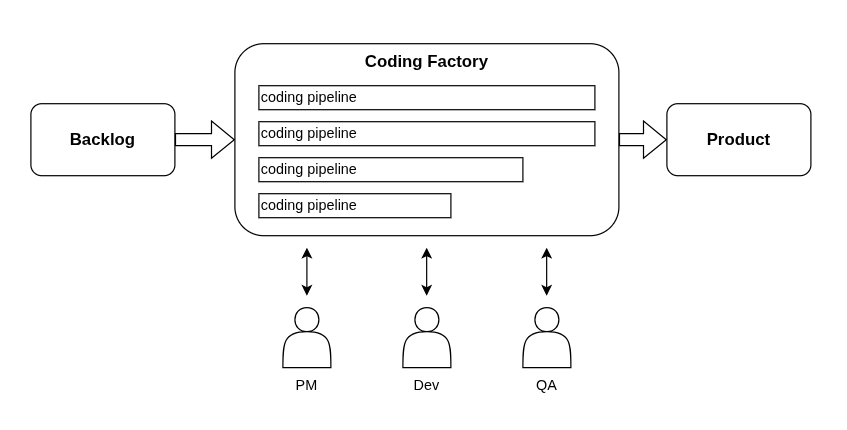
Imagine a relentless conveyor belt of code. In this model, the factory pulls tasks directly from project management tools like Jira. From there, it launches sophisticated coding pipelines by spinning up specialized coding agents. A coding pipeline is similar to a CI/CD pipeline, but it includes additional phases such as requirements refinement, design, coding, testing, refactoring etc. all powered by AI agents. These agents will write and rigorously test code until it meets predefined quality gates. They can even create ephemeral environments for further, more specialized testing and final human approval.
The Human-in-the-Loop: A New Partnership
In this model, the human role doesn’t disappear; it elevates. The coding factory promises a future where humans are no longer the builders on the conveyor belt, but rather the architects and supervisors of the entire system. Imagine a workflow integrated directly into your team’s existing communication channels (e.g. Teams or Slack) where coding bots can contact Product Owners, Developer, QAs associated to specific tasks and ask for clarifications or decision making when required.
Humans would be involved at several stages of the pipeline:
Requirements Input: A human product manager or lead developer defines a high-level task in Jira. No need to provide detailed specifications, acceptance criteria.
Requirements refinement: An AI agent pulls this task and begins its work. If it encounters ambiguity or needs a critical decision, it doesn’t just stop. It can ping the assigned human directly in a Teams channel, presenting the issue, a summary of its proposed solutions, and a request for a decision or clarification. For example: “Jira-1234: I’ve encountered an ambiguous requirement for the user profile page. Should the ‘last login’ timestamp be in UTC or the user’s local timezone? I need a decision before I can proceed.”
Design & Infrastructure Sign-off: The factory’s pipelines include automated checkpoints. Before an agent can start working on a sensitive feature, it might require a human to review and sign off on its high-level design plan or infrastructure changes, ensuring that the work aligns with broader architectural standards.
Implementation Support: Agents will be able to contact developers associated to a task any time they encounter major decisions or face difficulties.
Code Review & Approval: Once a coding agent’s work has passed its own internal quality gates (security, maintainability etc.), the coding pipeline creates an ephemeral environment for that task. This allows it to run E2E tests, performance tests, code analysis, other specialized agents for QA. Once all the additional phases are complete it will request reviews by several human collaborators. The developer will review the solution, the QAs will double check the QA agent report and perform additional manual testing and Product Managers will accept the feature.
The result is a continuous, efficient development process that never sleeps. This model dramatically compresses delivery times while simultaneously preserving essential accountability and compliance standards.
The Game-Changing Promise
The AI coding factory isn’t just an incremental improvement; it promises a step-change in software development:
- Reduced Time-to-Market: Stories that once took weeks to complete could shrink to days, or even hours.
- Reduced Costs: The cost-per-feature will fall sharply as API tokens, costing pennies, replace expensive developer hours.
- Massive Velocity Increase: Development velocity could increase by orders of magnitude, allowing organizations to innovate and deploy at unprecedented speeds.
The AI coding factory isn’t a distant dream; it’s the inevitable next frontier in software development. Are you ready for this revolution?